BrainSTEM Documentation & Support
Documentation, tutorials, and support resources for BrainSTEM.
Get started now Visit BrainSTEM.org
About BrainSTEM
This site provides documentation and support for BrainSTEM, a collaborative electronic lab notebook designed for experimental neuroscience. BrainSTEM captures and organizes the metadata of in-vivo and ex-vivo experiments, from subjects, surgeries and implants to recordings, imaging and behavior, and from tissue preparations to staining and slice physiology, through a modular, standardized data model that grows with new methods.
Whether you run a small lab or manage large collaborative projects, BrainSTEM provides the infrastructure to organize, share and access your experimental metadata with controlled vocabularies, versioned schemas and reproducible workflows.
Key features
- Complete experimental records: projects, subjects and specimen sets, procedures with their materials and the interfaces they implant, sessions with data acquisition, manipulations, behavior and epochs, all with type-specific, validated fields.
- Collaboration and compliance: object-level permissions through projects and groups, procedure episodes with severity classifications, licenses and protocols, and planned records.
- Shared resources and taxonomies: a catalog of consumables (including hundreds of silicon probe and ECoG array designs), hardware devices and suppliers; species, strains, atlases with brain-region trees and coordinate previews; new entries can be submitted with an RRID or DOI.
- Open science: one-click public sharing of projects, a public portal and API, versioned JSON exports, STAR Methods reports, and conversion to NWB files for DANDI.
- Programmable and AI ready: a REST API with Python and MATLAB tools, permanent URLs for every schema version and a machine-readable reference generated from the server; an in-app assistant that searches your records, an MCP server for Claude, Cursor and other assistants, and agent skills for coding agents, all bound by your permissions.
- Integrations: SoftMouse colony import, CSV and batch import, and an interactive data model to explore how everything connects.
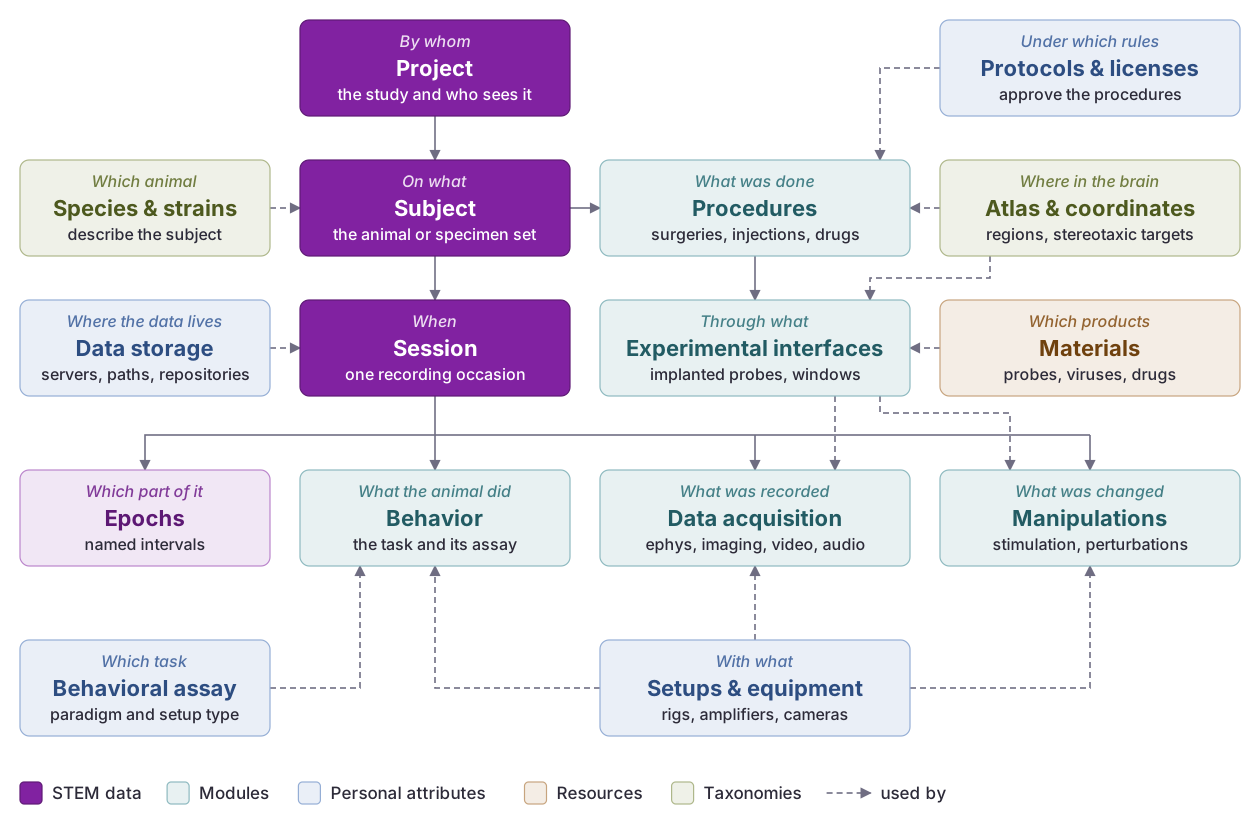
How BrainSTEM structures an experiment
A project holds the subjects, and each session records one occasion with a subject. Around them, BrainSTEM records what was done, what was recorded, with what, where in the brain, under which rules and where the data lives. Colours follow the apps of the data model.
Data model Web interface API Tools
Getting started
New to BrainSTEM? The tutorials guide you from account creation to complete experimental workflows.
For new users
- Setting up your first project, subjects and sessions
- Creating or joining research groups
- Understanding the BrainSTEM data model
- Forms, lists and entry pages of the web interface
For advanced users
- Ex vivo workflows with specimen sets, specimen procedures and slice sessions
- Public data sharing, exports and NWB conversion
- Submitting resources and taxonomies
- Working with the AI assistant, the MCP server and agent skills
Get started tutorial View all tutorials
Support and community
Get help
- FAQ: answers to the questions new users ask most
- GitHub Issues: report bugs and technical problems
- GitHub Discussions: ask questions, request features, and engage with the community
- Contact form: account-specific issues and direct support
Contributing
BrainSTEM thrives on community input. Whether you report bugs, suggest enhancements or take part in discussions, your contribution helps improve the platform for everyone.
Acknowledgments
BrainSTEM is supported by the Oxytocin U19 BRAIN Initiative Grant, enabling advances in collaborative neuroscience research infrastructure.
